
State Superintendent of Public Instruction Mo Green said North Carolina will have the best schools in the nation in five years.
That’s at least the premise of his strategic plan — approved by the State Board of Education earlier this month and developed after months of in-person meetings and virtual feedback sessions with students, teachers, and community members.
“When you talk about the fact of saying we want to be the absolute best, it’s a big statement,” Green said. “We don’t want to be Top 10. We want to be the absolute best.”
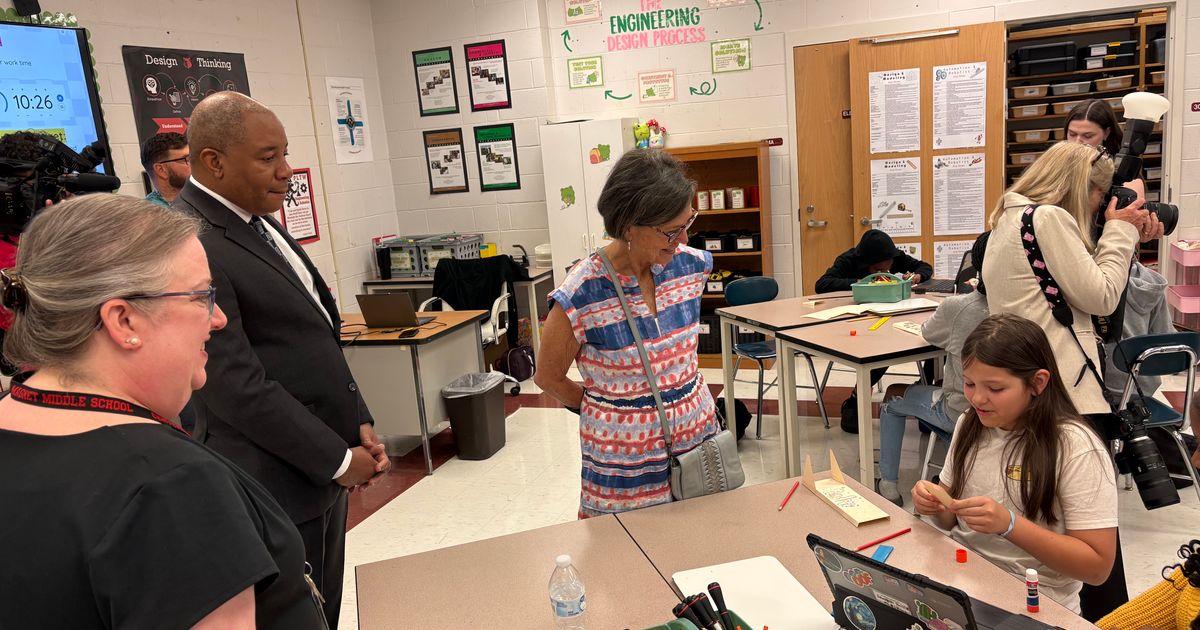
Green “launched” the strategic plan, called “Achieving Educational Excellence,” on Wednesday after touring classes at Centennial Campus Magnet Middle School in Raleigh. The school has a Center for Innovation, a type of thinking Green said is needed to make the strategic plan a reality.
“We already have a lot of the things we will need to make this plan successful,” Green said.
On Wednesday, Wake School leaders said they believed the plan was in line with the district’s goals, which include increasing graduation rates and test scores, among many other things.
The value of the plan, Wake Superintendent Robert Taylor said, “is about a unified vision across all public schools in North Carolina.”
The plan will also cost some money, require some policy or law changes, and necessitate coordination and partnerships with schools, families, and outside groups.
It will also require some reorganizing within the state Department of Public Instruction. That means realigning some priorities and setting aside some efforts not working as well, Green said.
Green said he’s not ready to share which programs could be set aside or canceled to make room for the plan. Those evaluations need to be completed, and the people need to be consulted first, Green said. But DPI is already looking into it.
He said DPI leadership has already asked state lawmakers for feedback during the creation of the plan, and he expects to have further conversations with them. They would be needed to increase funding or change education laws.
The department has already begun conversations with third parties that can help make some of the goals happen, Green said.
The strategic plan received applause from students, educators, elected officials, and community members invited to the launch on Wednesday. They lauded the plan for having specific goals that can be measured and including quarterly progress reports on each goal.
Those goal metrics include raising the four-year graduation rate from 86.9% in 2024 to 92% in 2030, an increase in the state ACT composite score average from 18.4 in 2024 to 20 by 2030, as well as higher national standardized test scores across reading and math tests in fourth and eighth grades. North Carolina is one of a handful of states that requires all high school students to take the ACT.
The plan also calls for a new teacher licensing system, more surveying of families and students, more access to career and college opportunities while students are still in school, as well as using artificial intelligence to make the state Department of Public Instruction run more efficiently.
Partnerships and fundraising are other explicit goals in the strategic plan.
The plan calls for establishing foundations and endowments to provide students with services and even free college classes. Other partnerships would help provide student services in areas like healthcare or help students achieve a statewide goal of reading 10 million books.
Green isn’t phased by the need to raise funds for the strategic plan because he believes in the department’s ability to work with outside groups and fundraise.
As he did earlier this month, Green told Wednesday’s audience of the time when he was superintendent of Guilford County Schools and still worked toward opening a science, technology, engineering, and math high school, despite losing millions of dollars in funding during the Great Recession.
The district eventually opened the school in partnership with North Carolina A&T University in 2012.
Still, some goals may need to be delayed, he said.
DPI has a team implementing the plan that will determine how much things cost, where the money can come from, and when certain things can be done or need to be done. The quarterly report will indicate whether a goal is on target or not. The state will also present annual statistics against the numeric goals listed.
The plan also outlines eight pillars over more than 30 pages, focused on competitive teacher pay, strengthening family engagement, physical and emotional safety, mental health, modernization of programs used by administrative staff and more.
According to the state, the strategic plan is the result of eight regional listening sessions, over 30 stakeholder meetings, and more than a dozen school visits across North Carolina. A first draft was shared in June at the State Board of Education meeting, and a final plan was approved by the board on Aug. 7.
